
How many applicants does a LinkedIn job get? Data from 8.9M jobs
84% of LinkedIn jobs have under 25 applicants 6–24 hours after posting, and only 2% show 200+. Country and job function matter far more than the myth suggests.
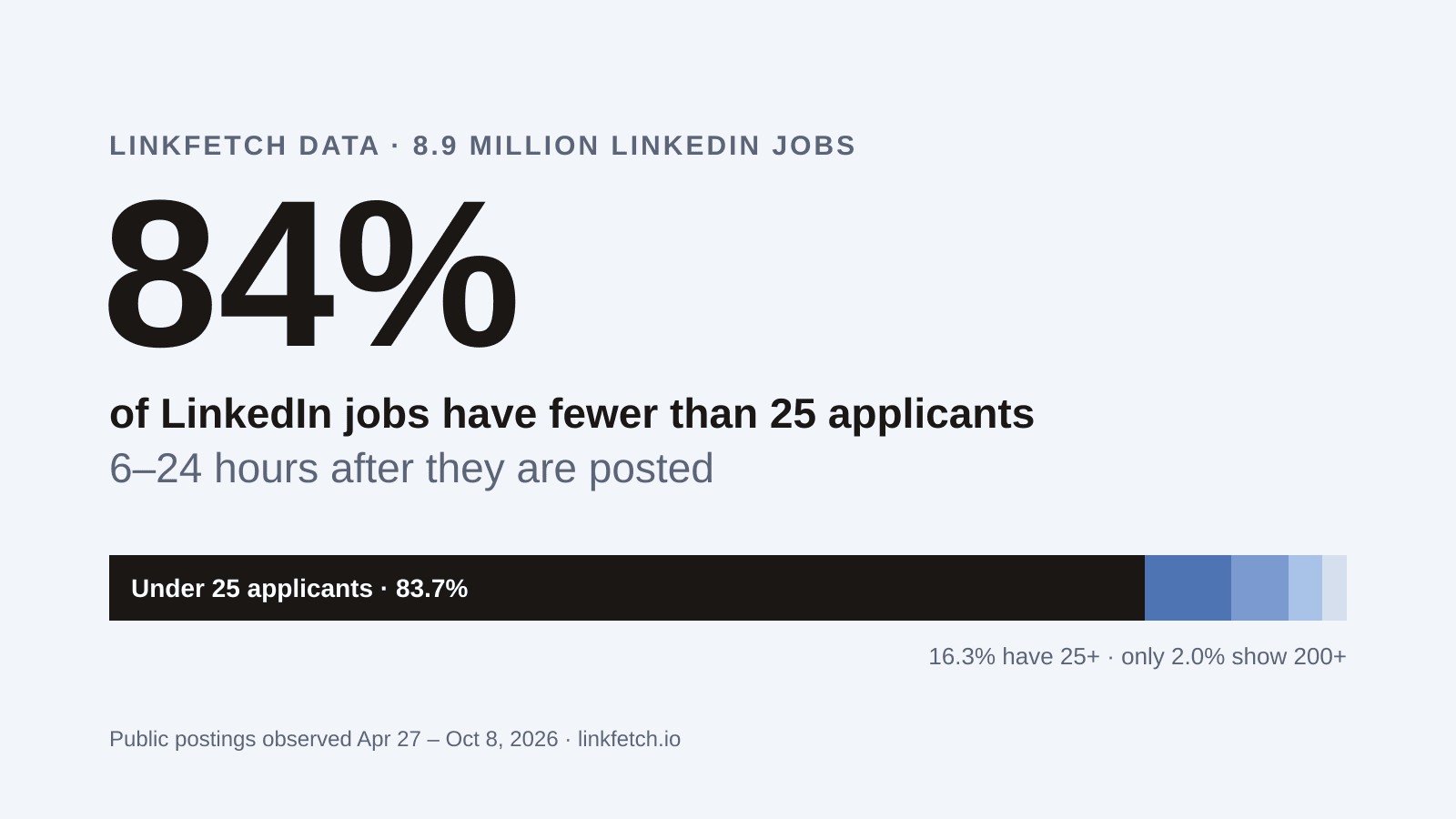
TL;DR: Most LinkedIn jobs are not buried in applicants. We tracked 8.9 million public postings between April 27 and October 8, 2026. Of the 447,302 we observed 6–24 hours after they went live, 83.7% still showed fewer than 25 applicants, and only 2.0% showed 200 or more. The crowding is real, but concentrated: in Saudi Arabia 84.7% of postings passed 25 applicants in that window, in the United States just 4.2%.
The usual answers to this question are a single number ("250 applicants per corporate job") that is widely repeated but rarely traced to data, or a screenshot of a posting that says "Over 200 applicants". We wanted the distribution, not an anecdote. LinkFetch, which tracks public LinkedIn job postings for its jobs dataset, records the applicant count LinkedIn shows on each posting when we fetch it. This post is what those counts look like at scale.
What does LinkedIn's applicant count actually measure?
Before the numbers, the instrument. On the public job pages we fetch, LinkedIn shows one of three things: "Be among the first 25 applicants", an exact number, or a capped "Over 200 applicants". So for any posting we know whether it is under 25, its exact count from 25 up, or that it has reached the 200 cap. Some guides, including Hiration's, describe the cap as "Over 100"; on the pages we see it is 200. The label may differ by view or may have changed.
The number is not a count of finished applications. Hiration's breakdown describes it as a tally of people who clicked Apply, including people who were sent to a company careers site and may never have finished, and notes that reposted jobs keep their applicant history. Recruiters such as Morton Philips add that the count includes many people who don't meet the core requirements. Read every figure below as "people who showed interest", which is an upper bound on real applications.
The second thing to know: we usually fetch a posting soon after it appears. The median posting in our sample was observed 52 minutes after it was posted. That makes this a study of the first day, which is when the question matters most for a job seeker deciding whether to bother.
How many applicants does a LinkedIn job get in its first day?
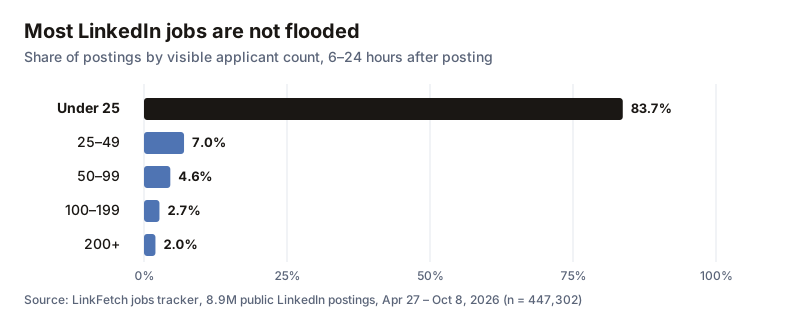
For a fair snapshot we took the 447,302 postings we observed between 6 and 24 hours after posting. Their applicant counts break down like this:
| Applicants shown | Postings | Share |
|---|---|---|
| Under 25 | 374,486 | 83.7% |
| 25–49 | 31,331 | 7.0% |
| 50–99 | 20,608 | 4.6% |
| 100–199 | 12,144 | 2.7% |
| 200 or more | 8,733 | 2.0% |
About five out of six postings are still in the "be among the first 25" band through most of their first day. The flooded posting you remember is real, but it is the 2% tail, and it is the one people screenshot.
How fast does a LinkedIn job pass 25 applicants?
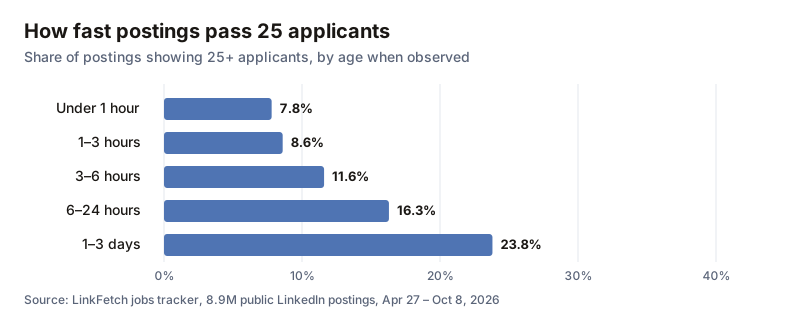
Each posting is observed once, so the buckets below are different postings, not the same jobs tracked over time. Postings we happened to catch later may differ in country or role mix. With that caveat, here is the share showing 25+ applicants by how old the posting was when we saw it:
| Age when observed | Postings | 25+ applicants | Showing "Over 200" |
|---|---|---|---|
| Under 1 hour | 5,214,768 | 7.8% | 1.4% |
| 1–3 hours | 3,042,608 | 8.6% | 1.4% |
| 3–6 hours | 167,215 | 11.6% | 1.2% |
| 6–24 hours | 447,302 | 16.3% | 1.9% |
| 1–3 days | 6,377 | 23.8% | 4.1% |
The last column counts postings flagged with LinkedIn's "Over 200" label, which is why it reads 1.9% where the distribution above (any count of 200 or more) reads 2.0%. We left out the 965 postings first observed more than three days after posting; the bucket is too small to read.
Two readings. First, the share showing 25+ is about twice as high in postings observed at 6–24 hours (16.3%) as in those observed in their first hour (7.8%). Second, 7.8% of postings already show 25+ in their first hour. Some of those are likely reposts carrying their applicant history; others may reflect an imprecise posting time. Our data cannot separate them. The 1–3 day bucket is small (6,377 postings), so treat it as directional.
Where do LinkedIn jobs fill up fastest?
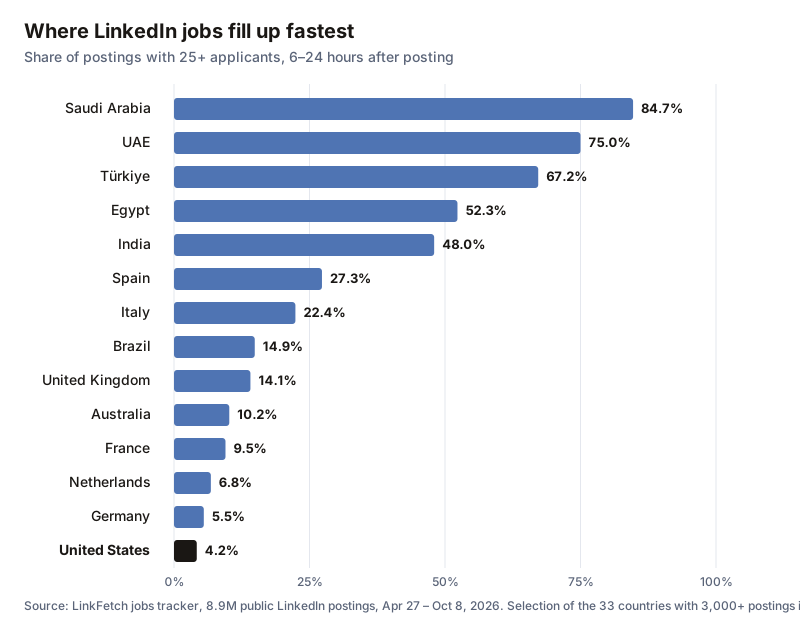
Country shows the widest spread of anything we looked at. A selection of the 33 countries with at least 3,000 postings in the 6–24 hour window:
| Country | Postings (6–24 h) | 25+ applicants | 200+ applicants |
|---|---|---|---|
| Saudi Arabia | 3,545 | 84.7% | 29.7% |
| UAE | 5,014 | 75.0% | 21.9% |
| Türkiye | 3,879 | 67.2% | 16.2% |
| India | 21,830 | 48.0% | 7.7% |
| Pakistan | 3,011 | 45.1% | 4.1% |
| United Kingdom | 10,900 | 14.1% | 0.8% |
| Germany | 24,267 | 5.5% | 0.3% |
| Austria | 5,047 | 4.8% | 0.2% |
| United States | 128,406 | 4.2% | 0.3% |
A posting in the UAE is about 18 times more likely than a US posting to pass 25 applicants on its first day, and dozens of times more likely to show 200+. Our data shows the gap, not its cause. Two explanations are likely: the US has far more postings competing for attention, and LinkedIn is the default job board in the Gulf and India in a way it is not in the US, where many applicants arrive through other boards, company sites and referrals that LinkedIn never counts.
If you are hiring in the Gulf or India, plan for volume screening from day one. If you are hiring in the US or Germany, the problem is more likely too few LinkedIn applicants than too many.
Which roles attract the most applicants?
Job function, as LinkedIn tags it, shows the next-widest spread. A selection of the 29 functions with at least 3,000 postings in the window (a posting can carry several functions, so the groups overlap):
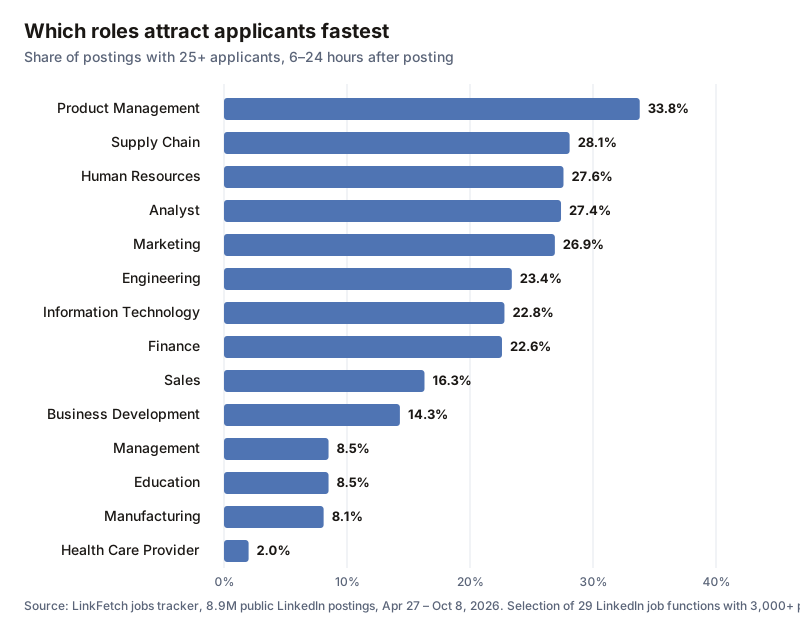
Office roles fill fastest: product management (33.8% past 25 applicants), supply chain, HR, analyst and marketing roles all sit above a quarter. At the other end, health care provider postings reached 25 applicants within a day only 2.0% of the time, manufacturing 8.1% and management 8.5%.
Senior postings were more crowded than junior ones. Director postings passed 25 applicants in the first day 31.3% of the time, against 18.7% for entry-level ones. The order is not perfectly tidy (executive sits below director, associate above mid-senior), and 64% of postings in the window carry no seniority tag at all.
| Seniority | Postings (6–24 h) | 25+ applicants |
|---|---|---|
| Director | 5,542 | 31.3% |
| Executive | 3,723 | 29.4% |
| Associate | 30,763 | 26.3% |
| Mid-senior | 78,667 | 24.5% |
| Entry level | 41,283 | 18.7% |
| Not specified | 284,593 | 12.1% |
Does showing a salary change how many people apply?
We checked, because it is a common claim. Worldwide, postings with a salary looked less crowded: 7.7% passed 25 applicants in the first day, against 17.2% without one. But at least part of that gap is geography: the Netherlands (32.3% of postings) and France (22.4%) show salaries far more often than India (4.2%), though Germany (4.9%) and Brazil (3.8%) are low-salary, low-crowding markets too. Inside the US the difference is small and goes the other way: 5.1% with a salary against 4.0% without. We would not draw a conclusion from this either way.
What this means for job seekers and recruiters
For job seekers: "Over 200 applicants" is rare, and applicant count alone is a weak reason to skip a role, especially in the US and Western Europe where most postings stay under 25 through most of their first day. Postings we saw later in their first day were about twice as likely to show 25+ as those we saw in their first hour, which suggests (but does not prove) that applying early means a smaller pile.
For recruiters and sourcers: in markets where LinkedIn is the main board, expect volume immediately and plan screening for it. Where postings sit under 25, waiting for applicants is the slow path, and proactive outreach is the faster one. That is the idea behind sourcing passive candidates without a Recruiter seat.
For anyone analysing the job market, applicant counts are one of the few public demand signals on LinkedIn. Paired with how many jobs LinkedIn adds every day, they show both sides of a market: how much is being posted, and how much attention each posting gets.
How we collected the data
LinkFetch is a LinkedIn data API and MCP server, and it maintains a tracker of public LinkedIn job postings. For this analysis we used every posting that met three conditions:
- LinkedIn gave an exact posting time (not a rounded "2 weeks ago").
- We fetched the full posting after that time.
- The page showed an applicant count or the "first 25" message.
That leaves 8,879,235 postings observed between April 27 and October 8, 2026. Each posting is counted once, at the moment we fetched it. LinkedIn shows counts of 200 or more as "Over 200", so we report a 200+ bucket rather than an average. That is also why this post has no "average number of applicants": with the top of the distribution capped and 84% of postings below 25, an average would be a made-up number.
Limits to keep in mind: we see the regions our tracker scans, not all of
LinkedIn; the count reflects Apply clicks, not finished applications; and
we have almost no view of what happens after a posting's first day. The
same data is available as the LinkFetch LinkedIn jobs dataset, including
applicant counts, and through the search_jobs tool in the LinkFetch MCP
server if you want to ask Claude these questions about your own market.
For context on how this kind of data is collected, see
the LinkedIn data API landscape,
or our Stripe leavers analysis for another
example built from public LinkedIn data.
FAQ
How many applicants does the average LinkedIn job get?
There is no honest single average, because LinkedIn caps the visible count at 200 and most postings are far below that. In our sample of 447,302 postings observed 6–24 hours after posting, 83.7% had fewer than 25 applicants, 14.3% had between 25 and 199, and 2.0% showed 200 or more. The typical posting is in the "be among the first 25 applicants" band on its first day.
What does "Be among the first 25 applicants" mean on LinkedIn?
It means fewer than 25 people have clicked Apply on that posting so far. LinkedIn shows this message instead of an exact number until a posting reaches 25. In our data it is by far the most common state: 83.7% of postings still showed it 6–24 hours after going live, and 92.2% of postings observed in their first hour.
Is "Over 200 applicants" on LinkedIn accurate?
It is a floor, not an exact figure. Once a posting reaches 200 applicants, the public page we fetch stops counting and shows "Over 200 applicants", so a posting with 201 and one with 5,000 look the same. The count also includes people who clicked through to a company site and never finished, and reposted jobs keep their applicant history.
Which countries have the most applicants per LinkedIn job?
In our data, postings in Saudi Arabia (84.7% past 25 applicants within a day), the UAE (75.0%), Türkiye (67.2%), Egypt (52.3%) and India (48.0%) filled up fastest. The United States was the least crowded at 4.2%, followed by Austria (4.8%), Japan (5.1%) and Germany (5.5%). That covers the 33 countries with at least 3,000 postings observed 6–24 hours after posting.
Should I still apply if a LinkedIn job has 200+ applicants?
Usually yes, if you fit the role well. The number counts clicks, many of which never become complete applications. Only 2.0% of postings show 200+ within a day. In our view, a referral or a direct message to the hiring manager is worth more than worrying about the count.