The Seed VC Monday Dealflow Playbook
A seed fund doesn't need a six-person sourcing team. With a Claude and LinkFetch agent that runs every Monday morning, a solo GP gets 20 ranked dealflow targets before the kettle finishes boiling. This playbook shows the four-step routine, the prompts, and the credit math.
Why most seed sourcing routines break by Wednesday
The problem isn't a lack of tools. It's a lack of a routine that survives contact with a busy week.
Most GPs we talk to start Monday with good intentions. Open Twitter. Skim a few Substacks. Check the founder-introduced inbox. By Wednesday, the dealflow list is a Google Doc with seven names and three half-finished notes. By Friday, it's a tab nobody clicked.
Meanwhile, the rest of the industry is automating. A recent VC Lab piece reported that 82% of firms now use AI for some part of deal sourcing research, and the firms moving fastest are the small ones. A solo GP with a working sourcing agent gets to the founder before the partner-led fund's analyst has finished their first Crunchbase export.
The agent isn't doing anything magic. It's running the same four steps a sourcing analyst would, but on a cron, with consistent prompts, and without the analyst's "I'll get to it tomorrow" failure mode. That's the whole edge.
The four-step Monday agent
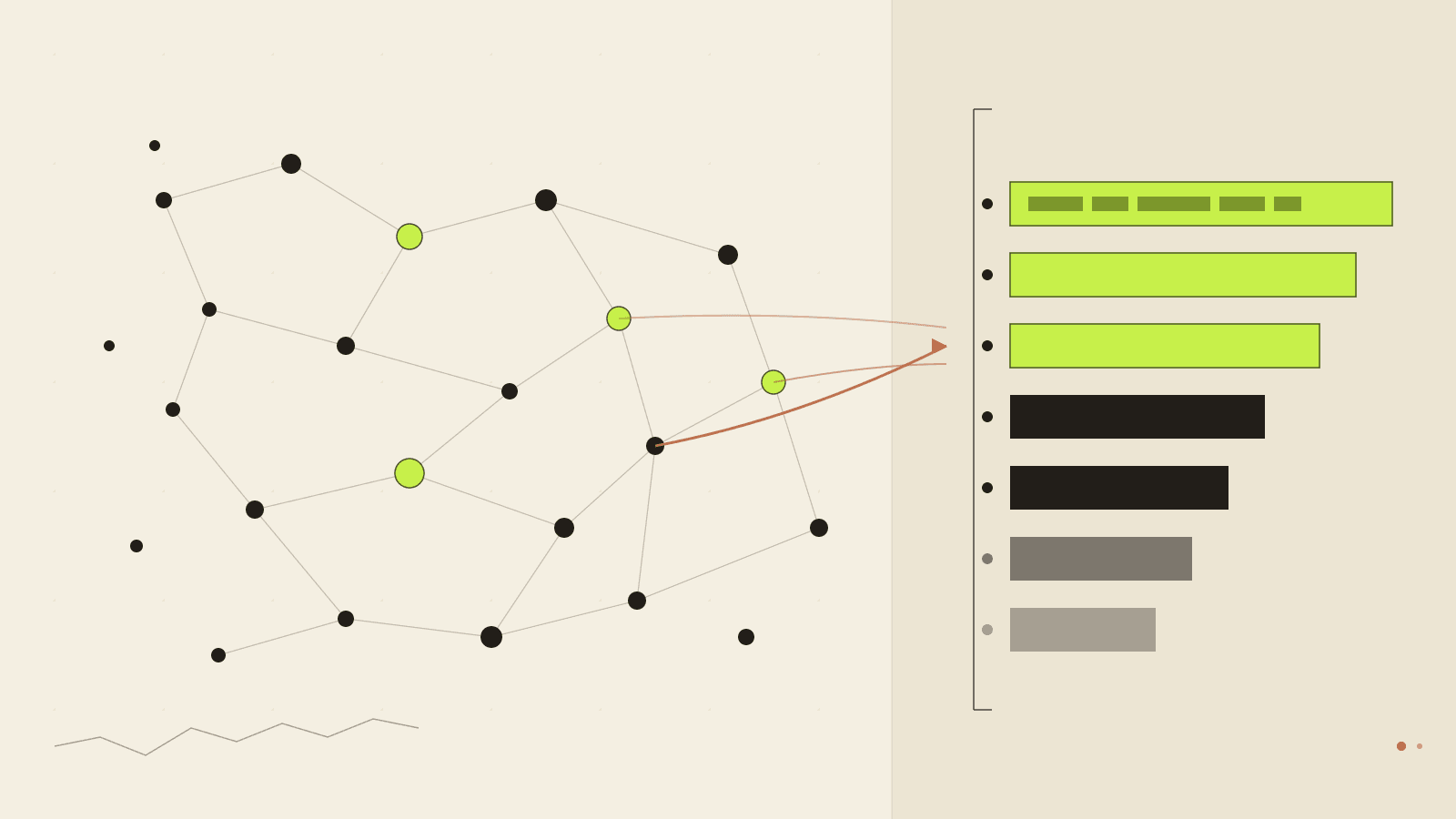
Here's the shape of the routine, top to bottom:
- Pull this week's signal set. Fresh company funding, headcount changes, and founder LinkedIn updates from your thesis universe.
- Filter to fit. Claude reads each signal against your written thesis (stage, sector, geo, founder profile) and keeps the matches.
- Rank by warmth. Cross-reference each founder against your LinkedIn graph and your portfolio's graph. One-hop wins. Two-hop is fine. Cold is last.
- Draft 20 intros. Claude writes a first-message draft for each, in your voice, with a specific hook from the signal that surfaced them.
The whole thing runs in about 12 minutes once it's wired up. The output is a Notion table (or Airtable, or a simple markdown file) with 20 rows, ranked, with a draft message in the last column. Your job is to read 20 rows over breakfast, mark which ones to send, and ship.
According to Affinity's 2026 round-up of VC AI tools, the firms reporting the highest win-rate lift were the ones that used AI for the boring repetitive parts of sourcing and kept humans on the judgement parts. This routine matches that pattern.
Step 1: Pull this week's signal set
The agent starts with three buckets of fresh signal, all from the past seven days:
- New funding rounds in your stage band. LinkFetch's
companiesendpoint takes a list of company URNs and returns last-funding-round metadata, employee counts, and HQ. Combine that with a public funding-tracker feed and you have a delta list. - Headcount accelerations.
companies.timeseriesover a 90-day window flags any company in your universe that grew engineering headcount more than 25% week-over-week. That's almost always a "they just raised" or "they're about to" signal. - Founder LinkedIn changes.
profileswith anupdated_sincefilter on a watch-list of repeat founders and ex-operators in your network.
A small note on universe construction. Most GPs we work with maintain a static list of about 2,000 companies they care about (their stage band in their sectors). That list is the input to step 1. LinkFetch pulls fresh data on the deltas, not the whole 2,000, so the credit cost stays bounded.
One Berlin-based seed fund running this routine has ~2,400 companies in their watch universe and pulls fresh data on roughly 60 per week (about 2.5% deltas). The rest stay in the static cache.
Step 2: Filter to fit with Claude
Now you have maybe 80 raw signals. Most of them are noise. A 1,000-person scale-up raised a Series D. A US Series B closed in your French-Series-A fund's wrong geography. A founder went on parental leave and updated their headline.
This is where Claude does the thesis math.
You write your thesis once, in plain English, in a markdown file the agent reads at the start of every run. Example: "We invest €500k to €2M into European-headquartered, technical-founder-led companies in the developer-tools, security, or fintech infrastructure sectors at pre-seed or seed. We pass on consumer, marketplaces without a clear data moat, and anything where the lead founder hasn't shipped production code."
Claude reads that file, then walks the 80 raw signals and tags each one fit / maybe / pass with a one-sentence reason. The pass pile gets dropped. The fit and maybe piles move forward.
In practice the filter knocks the list down to 25 to 35 candidates. That's the headline number: from 2,400 universe to 80 fresh signals to 30 thesis-fit candidates in about four minutes of compute.
The key prompt trick is to give Claude both the signal and the public LinkFetch profile of the founder. Decisions made from a headline and a one-line bio are bad. Decisions made from a full work history, the company description, and the funding context are sharp enough to trust.
Step 3: Rank by warmth
A ranked list with no warmth signal is just a long list. You'll work the top three, ignore the rest, and waste the rank.
This step adds the network layer.
For each of the 30 candidates, the agent runs two graph queries:
- Your first-degree graph. Does the founder share any connection with you? Old colleagues, school, prior portfolio. LinkFetch's profile endpoint returns mutual-connection counts and the top three mutuals.
- Portfolio graph. Does anyone at any portfolio company know this founder? Same query, broader root set.
Each candidate gets a warmth score: zero for cold, one for two-hop via a strong tie, two for one-hop. The agent re-sorts the 30 candidates by thesis_fit_score × warmth_score. The top 20 ship. The rest go to a "watch next week" file.
A bias correction worth knowing about. According to Evertrace's 2026 sourcing report, 71% of seed deals in European tech still close through warm intros, not cold outbound. So the warmth re-rank isn't a nice-to-have. It's the variable that most predicts whether you'll actually get a meeting.
One ediit a few funds make at this step: weight the warmth score higher for any founder a portfolio CEO has explicitly flagged in the past 30 days. Those signals almost never miss.
Step 4: Draft 20 intros
Now the agent writes the actual messages. This is the step most people skip because it feels too automated to be sincere. It isn't, if the prompt is right.
The pattern that works:
- Open with the specific signal that surfaced the founder ("Saw your team just crossed 12 engineers and you closed the seed last month").
- State a thesis match in one line ("We've been looking for technical founders building in dev-tools security and you're squarely in our band").
- Reference the warm tie explicitly if there is one ("Sarah Lin at Acme mentioned you in passing last Q3").
- End with one clear ask, low-cost ("Open to a 20-min call next Wed or Thu?").
Claude can draft 20 of those in 90 seconds. Your job is to read each one, fix the tone where it sounds robotic, and decide which to send. About 14 of 20 ship as drafted. The other six get heavier edits or you skip them entirely.
A small reality check. These drafts are not magic. They're decent first drafts. The model can't know that the founder you're writing to just had a bad term sheet experience with a peer fund and is in a sour mood. That kind of context still lives in your head. The agent does the 80% so you can spend your judgement on the 20% that matters.
What it actually costs
The honest cost breakdown for a week of this routine:
| Step | LinkFetch credits | Claude tokens (rough) |
|---|---|---|
| Pull signals (60 companies + 30 profiles) | ~90 | minimal |
| Filter to fit (Claude reads 80 signal docs) | 0 | ~30k input |
| Warmth rank (60 graph queries) | ~60 | minimal |
| Draft 20 intros | 0 | ~15k output |
| Buffer for re-pulls | ~30 | ~10k |
| Total | ~180 credits / week | ~55k tokens / week |
At LinkFetch's standard rate, 180 credits is about what one ad-hoc Crunchbase Pro export of similar depth would cost, except this runs every week without you opening a browser. The Claude side is well under $1 at June 2026 Sonnet pricing.
The bigger cost is the day-zero setup. Wiring up the agent (universe file, thesis file, network graph fetch, output template) takes about half a day if you've never used MCP before, and an hour if you have. Once it's running, the weekly time goes from three hours to twelve minutes.
For the prompt side of the build, the 12 Claude prompts for VC investors post has the full set ready to copy-paste. And if you want to see the same data flow from the founder's side (the people writing to you), the mirror image from the founder side walks through the outbound playbook a pre-seed founder runs against funds like yours. For a deeper credit-by-credit breakdown of what a weekly run actually costs across LinkFetch and alternative providers, the cost comparison is up.
Frequently asked questions
Does this scrape LinkedIn?
No. LinkFetch is a compliance-first LinkedIn data API that operates on public data, with each request originating from an authenticated user's session through their browser extension. The data you get back is the data the founder chose to make public on their own profile. No scraping farms, no bypass of rate limits, no rented accounts.
Will the agent surface stealth founders before they're on Crunchbase?
Sometimes. The headcount-acceleration signal often fires three to six weeks before the funding announcement, because the team starts hiring before the round is public. The LinkedIn updated_since signal catches founders updating their title before any database picks it up. Neither is guaranteed, but both run cheap so they're worth keeping in.
How is this different from Affinity or Harmonic?
Affinity is a CRM and Harmonic is a database. LinkFetch is the data layer underneath an agent you write yourself. If you want a polished UI and a sales rep to call, use Affinity. If you want a custom routine that ranks deals by your specific thesis and your specific network, this stack is more flexible and a lot cheaper.
What if my thesis changes mid-quarter?
Edit the thesis file. The next Monday run picks up the new criteria automatically. One fund we work with revises their thesis file every six weeks based on what's actually closing. The agent adapts the same day.
How do I avoid burning my LinkedIn network with too many cold messages?
The intro draft step is a draft, not a send. The agent never sends a message on its own. You read each one, decide which to send, and ship from your own LinkedIn or email. Twenty drafts per week is also well below any reasonable account-hygiene threshold; most GPs end up sending six to twelve.
Can the agent score deals on more than fit and warmth?
Yes. The common extensions are momentum (employee growth rate over the past 60 days), founder pedigree (prior exits, prior YC, technical signals), and inbound-vs-outbound flag. Each adds one column to the ranking table. We'd suggest getting the four-step base running for a month before adding columns. Premature scoring complexity is the most common reason a sourcing agent stops getting touched.
Last updated 2026-06-15 by the LinkFetch team.